
A question we hear regularly from Manor homeowners is a version of this: ” My house is only seven years old, so why did my garage door spring already fail?” The honest answer is that the springs that come with new construction homes aren’t built for longevity. They’re built for cost.
Manor is one of the fastest-growing communities in Travis County, and most of its housing stock is new construction from the 2010s and 2020s. Those homes came with builder-grade springs, which are lighter-duty and rated for fewer cycles than the aftermarket springs used in proper replacements. The standard is a 10,000-cycle spring, which feels like a lot until you do the math on a busy Manor household. Add Austin’s heat cycling, high daily use (the garage is the primary entry point for most Manor families), and you get spring failures at 5 to 8 years that genuinely surprise homeowners.
We’re part of the eastern corridor service area that covers Manor, Del Valle, Elgin, and Bastrop. Spring replacement in Manor is one of our most common calls. Here’s what you need to know about why it happens, what to do about it, and how to extend the life of your next set of springs. For the full service list for Manor, see all services in Manor TX.
Why Manor TX Homes Have More Spring Failures Than Older Suburbs
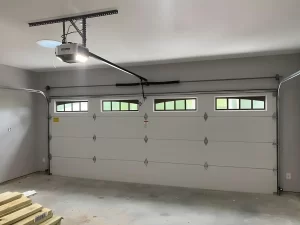
Three factors combine to make spring failure more common in Manor than in established Austin neighborhoods:
Builder-grade springs. Builders select springs for cost efficiency, not longevity. The springs installed in most Manor new construction are rated for approximately 10,000 cycles, about the same as standard extension springs. That rating translates to roughly 7 to 10 years of average use, and less in a high-use household.
High daily use. In Manor, the garage door is typically the primary entry and exit to the house. A family using the garage 6 to 8 times per day can burn through 10,000 cycles in 4 to 5 years. At that rate, springs rated to last nearly a decade fail in about half that time.
Austin’s heat. Garage interiors in Manor reach 110 to 120 degrees Fahrenheit in summer. That heat accelerates metal fatigue in spring coils and dries out lubricants faster than in cooler climates. Springs in unlubricated, high-heat conditions wear out noticeably faster than manufacturer ratings assume. For Manor homeowners, this means building lubrication into the annual maintenance routine, not just addressing it when the door starts making noise.
Warning Signs Your Manor Garage Door Spring Is Failing
Springs don’t always snap without warning. These signs usually appear first. See our full warning signs your springs need replacing guide for more detail, but the Manor-specific things to watch for:
- The door feels heavier than it used to when lifting manually. That’s the spring losing tension.
- The door moves unevenly or tilts to one side when opening or closing. One spring may be losing tension faster than the other.
- The opener sounds like it’s straining or running slower. When springs weaken, the opener motor carries more of the door’s weight.
- A loud bang from the garage, followed by the door not opening. That’s a torsion spring fracturing. The door shouldn’t be operated with the opener until the spring is replaced.
- Visible gap in the spring coil above the door. A torsion spring with a gap has broken and needs to be replaced.
Torsion vs Extension Springs in Manor Homes
Most Manor homes built after 2010 have torsion spring systems: a single coil (or two coils for heavier doors) mounted on a horizontal shaft above the door opening. Torsion springs last longer, operate more smoothly, and are safer when they fail than extension springs. See our torsion vs extension springs guide for the full comparison.
Older properties in the Manor area, particularly those built before 2000, may have extension springs running along the horizontal track sections on either side of the door. These are the long, thin springs you’d see above the side tracks. Extension springs require safety cables running through each coil to prevent dangerous failure. If yours don’t have safety cables, that’s the first thing to address.
Same-Day Spring Replacement in Manor TX
Manor is about 25 minutes from our central Austin base. We regularly run routes through the eastern corridor and stock the torsion spring sizes common in Manor’s new-construction homes on every truck. That means most Manor spring replacements don’t require a parts run.
When you call, we’ll ask about your door: single- or double-car, approximate weight, and whether it’s steel or wood. That lets us confirm we have the right spring size before arriving. For standard Manor new-construction homes (steel sectional, LiftMaster, or Chamberlain opener), we’re almost always in stock and ready.
For pricing details, see our spring cost breakdown. We provide you with a written quote before we start. If you’re also having opener issues alongside the spring, that’s a separate conversation about opener replacement, something we also handle in Manor.
Should You Upgrade When You Replace?
When a builder-grade spring fails in a 5 to 7-year-old Manor home, you have two options: replace like-for-like with a standard spring, or upgrade to a high-cycle aftermarket spring.
The upgrade case is straightforward for Manor homes. A standard replacement spring will fail again in another 5 to 8 years at Manor usage rates, which, for an active family, means scheduling spring service two or three times over the life of the home. A high-cycle spring rated for 20,000 to 30,000 cycles roughly doubles the time before the next replacement. The upfront cost is higher, but spread over a longer service life, the per-year cost is lower. For Manor families who use the garage as the primary entry point, that extra longevity makes a real difference in how often you schedule spring service.
We’ll show you both options and the cost difference so you can decide. There’s no pressure either way. If the budget is tight right now, a standard replacement is a perfectly fine repair.
How Austin’s Heat Affects Springs in Manor Homes
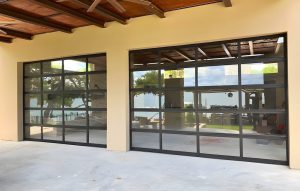
Manor garages are typically uninsulated or lightly insulated, which means interior temperatures track closely with the outdoor heat in Texas. In a summer that pushes temperatures outside to 105 degrees Fahrenheit, the garage interior can reach 115 to 120 degrees. That temperature does several things to garage door springs:
- Metal fatigue accumulates faster at high temperatures. The expansion and contraction of metal coils over hundreds of heat cycles accelerates wear at the molecular level.
- Lubricants evaporate or thin out more quickly. A spring lubricated in February may be running dry by July, increasing friction with every cycle.
- Rubber and vinyl components adjacent to the spring (seals, trolley parts) also degrade faster in heat, compounding the overall system wear.
Lubricating springs annually with a silicone spray is the single most effective maintenance step for Manor homeowners. Our broader Austin garage door team is available 24/7 for spring replacement calls across Manor and the eastern corridor. Call (512) 796-4985 or schedule your Manor service call online. We’ve been fully insured and serving Austin since 2010.
