
Every garage door has springs. Most homeowners don’t think about them until something goes wrong. But knowing which type of spring your door uses, how long it lasts, and what happens when it fails is genuinely useful information, especially when it’s time to repair or replace, and someone’s asking whether you want to upgrade.
There are two types: torsion and extension. They work differently, fail differently, and have meaningfully different lifespans. Our spring repair in Austin team works on both every day. Here’s what you need to know before the next service call.
If you’ve already noticed something off with your door, read our signs your springs need replacing guide first, then come back here for the deeper comparison.
How to Tell Which Type of Spring Your Garage Door Has
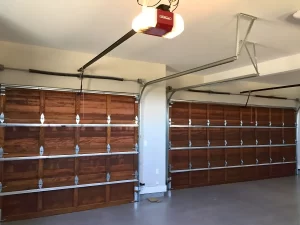
This takes about ten seconds. Stand in front of your closed garage door and look up:
- Torsion spring: You’ll see a thick, tightly wound coil mounted horizontally on a metal shaft directly above the door opening. Most doors have one spring on the shaft. Heavier or wider doors have two. The coil is usually painted or has a colored stripe indicating its weight rating.
- Extension springs: You’ll see two long, thinner springs running parallel to the ceiling on both sides of the door, positioned above the horizontal tracks. They extend the full length of the horizontal track section. Look for cables running through them as well.
If you’re still not sure, a quick rule: if the spring is above and across the top of the door, it’s torsion. If the springs are on the sides, running back along the ceiling, they’re an extension.
How Torsion Springs Work
A torsion spring is mounted on a solid steel shaft above the closed door. When you close the door, the spring winds tighter, storing mechanical energy through the twisting motion. When you open the door, the spring unwinds slowly and evenly, transferring that stored energy through the shaft to the cable drums on each end. The drums wind the cables, and the cables lift the door.
Because the force is distributed across the shaft and applied to both sides of the door simultaneously, torsion systems lift more smoothly and evenly than extension systems. There’s no side-to-side variation in tension.
If a torsion spring breaks, it typically fractures on the shaft and stays contained within its mounting. It doesn’t snap free. This is the key safety advantage of the torsion design.
How Extension Springs Work
Extension springs work differently. They’re mounted on both sides of the door, above the horizontal track sections. When the door closes, the springs stretch, storing energy in the elongation. When the door opens, the springs contract, pulling cables through the pulleys to lift it.
Because each side has its own spring, there’s an inherent risk: if one side wears faster than the other, the door can lift unevenly. You’ll notice this as tilting, jerking, or binding in the tracks.
The bigger concern with extension springs is what happens when they break. Without safety cables, a broken extension spring can snap and fly across the garage at high speed, damaging anything in its path. If your extension springs don’t have garage door cable safety cables running through each coil, that’s the first thing to address before any other maintenance.
Side-by-Side Comparison: Lifespan, Safety, and Performance
Torsion Springs | Extension Springs | |
|---|---|---|
Location | Above the door on a horizontal shaft | Along both sides, above the tracks |
Lifespan | 15,000-20,000 cycles (10-15 years) | 7,000-10,000 cycles (5-8 years) |
Operation | Smooth, even, balanced | Can be uneven if one side wears faster |
Noise | Quieter | More vibration and noise over time |
Safety if broken | Stays on the shaft (contained) | Can snap and fly without safety cables |
Best for | Heavier, wider, or insulated doors | Smaller, lighter, single-car doors |
Overhead space | Needs standard headroom | Works in low-headroom garages |
Long-term cost | Lower (fewer replacements) | Higher (more frequent replacement) |
Which Type Is More Common in Austin TX Homes
Austin’s housing stock spans a wide range. Here’s what we typically find:
Post-2000 construction. The vast majority of homes built after 2000 in Round Rock, Pflugerville, Cedar Park, Manor, and the newer Austin suburbs have torsion springs. Modern garage doors are heavier (insulated steel, carriage-style), and torsion systems are the standard for those weights.
1970s-1990s construction. Homes from this era are more likely to have extension springs, especially single-car garages. Many have been retrofitted with torsion systems over the years, but plenty still have the original extension spring setup.
Older Austin neighborhoods. Areas like Hyde Park, Allandale, Bouldin Creek, and Tarrytown have older housing stock. If you’re in one of these neighborhoods and haven’t had spring work done recently, there’s a reasonable chance you still have extension springs.
When we arrive for a spring service call, we’ll tell you exactly what you have before starting any work.
Should You Upgrade from Extension to Torsion Springs
If your extension springs need replacement, it’s worth asking whether upgrading to torsion makes sense. Here’s an honest way to think through it:
- An upgrade makes sense if your door is heavy or insulated, you use the garage as a primary entry point, you want fewer service calls over the next decade, or safety is a priority (especially with kids or pets in the garage).
- Stay with extension if: the door is a small, lightweight single-car that you rarely use, or your garage has limited headroom that won’t accommodate a torsion shaft and mounting brackets.
- Cost to consider: upgrading involves more hardware than a like-for-like replacement. See what spring repair and replacement costs for a breakdown of both scenarios.
If you’re not sure, we’ll give you an honest assessment during the service call. We won’t push a more expensive option if it doesn’t make sense for your door.
How Austin’s Climate Affects Both Spring Types
A few things specific to the Austin area affect how long springs last:
Heat cycling. Austin garage interiors regularly hit 110-120 degrees Fahrenheit in summer and drop to near freezing in some winters. That temperature range causes metal to expand and contract repeatedly, accelerating metal fatigue in both spring types. In colder climates, manufacturer cycle ratings hold up well. In Austin’s heat, real-world lifespan can run 10-15% shorter.
Humidity and rust. Central Texas humidity, especially in wet seasons, promotes surface rust on spring coils. Rust weakens the metal and creates failure points. Regular lubrication with a silicone-based spray significantly slows this. See our spring maintenance tips for the specific steps and how often to do them.
High-use garages. In fast-growing Austin suburbs, the garage is often the primary way in and out of the house, meaning 8-10 cycles per day rather than the 2-4 assumed in standard manufacturer ratings. At that pace, extension springs can need replacement in as few as 3-4 years, and torsion springs in 6-8 years.
If you’re not sure when your springs were last replaced or what type you have, get your springs inspected. We’ve been fully insured and serving Austin since 2010, and most inspections take under 30 minutes. Call (512) 796-4985 or book online. We offer our garage door repair services in Austin 24/7 across the metro.
