
When a residential garage door fails, it’s an inconvenience. When a commercial door fails, it’s a business problem. Loading operations stop. Deliveries get backed up. Security exposure opens up. The cost isn’t just the repair: it’s every hour your facility isn’t running at full capacity.
Commercial garage door systems are fundamentally different from residential ones. The springs are heavier, the operators run on different power configurations, and the cycle counts are far higher. A door at a busy distribution center might open and close 80 to 100 times a day. A residential door opens 4 to 6 times. That difference matters for how repairs are approached, what parts are needed, and how fast a technician needs to be there.
Our commercial repair service covers warehouses, auto shops, retail loading bays, distribution centers, and fleet garages across Austin. We’re fully insured and available 24/7. Here’s what business owners and facilities managers need to know.
How Commercial Garage Door Repair Differs from Residential
The core difference is load and cycle count. Commercial systems are built for it; they also wear out faster because of it.
Springs. Commercial torsion springs are heavier-duty and sized to specific door weights, with capacities of 600 to 800 pounds for large rolling steel doors. They’re rated for higher cycle counts than residential springs but still have a finite lifespan. When they fail, the door is inoperable. Our spring repair service covers commercial spring sizing and replacement.
Operators vs openers. Residential systems use openers. Commercial systems use operators, which are heavier motor units rated for high cycle counts and often run on 208-240V or three-phase power. Operators can also integrate with access control systems, loop detectors, and security panels. Repair requires different tools and expertise than residential opener work.
Track and hardware. Commercial doors run on heavier gauge tracks with larger rollers and reinforced brackets. High-cycle use causes gradual track wear, hardware loosening, and roller degradation at a faster rate than in residential systems. Minor misalignment that would be inconvenient on a residential door can become a safety issue on a heavy commercial door.
Types of Commercial Overhead Doors We Repair
- Sectional steel doors. The most common type in Austin warehouses and distribution centers. Panels hinge together and roll up along a track. We repair panels, springs, cables, tracks, and operators. These are also available for commercial door installation if repair isn’t the right call.
- Rolling steel doors. A single curtain of interlocking steel slats that coils above the opening. Common in self-storage, loading docks, and industrial facilities. We repair coil springs, slats, bottom bars, guides, and operators.
- Standard commercial overhead doors. Heavier versions of residential-style sectional doors are used in auto shops, fire stations, fleet garages, and light commercial buildings. We service springs, cables, rollers, tracks, and operators for all major commercial brands.
Most Common Commercial Garage Door Failures in Austin
These are the failures we see most often on commercial service calls:
Spring failure. Heavy commercial torsion springs fail from metal fatigue after their rated cycle count is exceeded. A broken spring on a commercial door means the door won’t move until it’s replaced. This is always a same-day repair. Facilities can’t afford to wait.
Operator failure. Commercial operators fail due to power surges, worn motor components, and control board issues. In Austin, thunderstorm-related voltage spikes cause more operator failures per year than in drier climates. A surge protector on your operator’s power supply is cheap insurance.
Track misalignment from impact. Forklifts, delivery trucks, and loading equipment occasionally strike door frames, tracks, or panels. Even a minor hit can pull a track out of alignment enough to make the door bind or jump. Our commercial track repair team handles both track realignment and panel replacement.
Roller and hardware wear. High-cycle commercial doors wear rollers, hinges, and brackets faster than most operators realize. Grinding sounds, increased motor load, or uneven movement are all signs that rollers or hardware need inspection before a larger failure occurs.
Cable failure. Commercial lifting cables fail from the same causes as residential cables, just faster due to higher cycle counts. A cable failure on a large commercial door can cause the door to drop suddenly and asymmetrically, damaging the door and creating a safety hazard.
Why Downtime Is the Real Cost of a Commercial Door Failure
The repair cost is rarely the biggest number when a commercial door goes down. The higher cost is what keeps it down.
Loading dock operations halt. Delivery schedules get backed up. Climate control fails for temperature-sensitive facilities. Security exposure opens up if the door is stuck in the open position. For businesses that use the door as a primary access point, an outage can mean employees standing around waiting.
This is why response time matters more for commercial calls than for residential ones. We treat commercial door failures as priority calls and stock heavy-duty commercial parts on every truck. For true emergencies (a door stuck open on a secure facility or a loading dock that’s completely down), our emergency commercial repair service is available 24/7.
What to Expect from a Commercial Service Call
Our commercial service process is straightforward:
- We arrive with commercial-grade parts. Torsion springs, heavy-duty rollers, commercial cables, and operator components are on every truck, so most repairs don’t require a parts run.
- We diagnose before quoting. You get a written cost breakdown covering parts and labor before any work starts. No surprises.
- We test before we leave. Every commercial repair ends with a full operational test: auto-reverse verification, safety sensor check, balance test, and operator response check.
- We document the work. For facilities managers who need a record of repairs for compliance or insurance purposes, we provide written service documentation on every commercial call.
Preventive Maintenance for Austin Businesses
Most commercial door failures are preventable. High-cycle doors should be professionally inspected every six months. Lower-use commercial properties can go twelve months between service calls, with basic visual checks in between.
A preventive maintenance visit covers spring inspection, cable inspection, roller and hardware check, lubrication, track alignment, operator calibration, and safety sensor testing. Catching a worn cable or a spring near the end of its rated cycles costs a fraction of what an emergency same-day repair would cost after a failure. Our preventive maintenance program details the full schedule and what each visit covers.
For facilities with multiple doors, a service agreement gives you scheduled visits, priority scheduling, and discounted rates. Most warehouse and distribution facilities in Austin with four or more doors find that an agreement pays for itself within the first avoided emergency call.
Austin’s Commercial Growth and What It Means for Your Doors
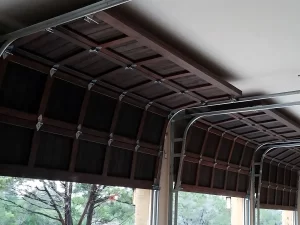
Austin’s commercial and industrial sector has grown significantly over the past decade. Tesla’s Gigafactory east of Austin, Samsung’s Taylor plant, and the continued expansion of distribution and logistics operations along the I-35 corridor and around Austin-Bergstrom have brought new warehouses, distribution centers, and fleet facilities to the market. Most of these facilities have commercial overhead door systems that cycle far more than the average residential door.
The heat also matters. Austin garage and warehouse interiors regularly reach 110-120 degrees Fahrenheit in summer. That temperature stresses commercial springs and operators faster than manufacturer ratings assume. Facilities in areas like Del Valle, Manor, Pflugerville, and the I-35 industrial corridor should factor in Austin’s climate when setting inspection schedules.
Get a same-day estimate for your commercial door issue, or call (512) 796-4985 to speak with a technician directly. We’re fully insured and have been serving Austin businesses since 2010. Our full-service garage door repair team is available 24/7 across the Austin metro.
