
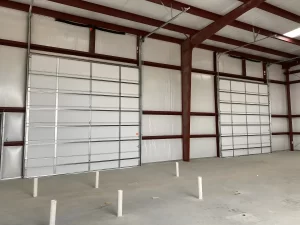
 Choosing a commercial overhead door involves more variables than a residential purchase. Door type, gauge, insulation level, operator specifications, security features, access control requirements, and code compliance all affect the decision — and the wrong choice leads to premature failure, operational disruption, or inspection issues. A commercial overhead door assessment from All Points Garage Doors covers all of these factors at no charge. This guide walks through each decision point so you understand the options before the conversation.
All Points Garage Doors has been fully insured and handling commercial overhead door installation, service, and repair across Cedar Creek, Bastrop, Del Valle, Lockhart, and the Austin corridor since 2010. The considerations below reflect the specific conditions of the Central Texas commercial market.
Step 1: Choose the Right Door Type
The first decision is the door type, which is driven by your available space and application.
Sectional Overhead Doors
Sectional doors are the most common commercial door type in the Austin area. Horizontal steel panels travel up a vertical track and back along a horizontal track parallel to the ceiling. They work well in most standard commercial bays, warehouses, and service facilities. They require ceiling clearance — typically 12 to 18 inches above the door opening for the track curve — and enough headroom for the horizontal track run.
Rolling Steel Doors
Rolling steel doors coil into a barrel above the opening and require no ceiling track space. They are the right choice when headroom is limited — in spaces with low ceilings, steel I-beams, or HVAC equipment that prevents standard sectional track installation. Rolling steel is common on storefronts, self-storage facilities, and service bays in the Cedar Creek and Bastrop commercial zones where older agricultural buildings have limited overhead clearance. Rolling steel doors come in service, commercial, and industrial grades, differentiated by curtain gauge and slat profile. Service-grade rolling steel is appropriate for light commercial use. Industrial-grade rolling steel with 20-gauge or heavier slats is appropriate for high-traffic loading operations or security-critical applications. Rolling steel requires a dedicated commercial rolling operator — the coiling mechanism and door weight are incompatible with standard sectional door openers.
High-Speed Doors
High-speed fabric doors open and close in 1 to 3 seconds and are used in applications where rapid cycling is critical — temperature separation between a cold storage facility and a loading dock, or high-traffic manufacturing environments. They are less common in the Cedar Creek corridor but appropriate for any Austin business where door cycle speed is operationally significant.
Step 2: Size the Door Correctly
Sizing errors are among the most common and most expensive commercial door mistakes. For commercial door sizing and installation, the standard practice is to size the door 2 feet wider and 1 to 2 feet taller than the largest vehicle or load that needs to clear the opening. This accounts for mirrors, raised loads, and normal driving variation.
For loading dock applications, verify the dock height and the highest trailer floor level you will handle. A dock door that is too short for a high-floor trailer creates a safety hazard and damages loads. Measure the actual vehicles and equipment that will use the door before finalizing dimensions — do not rely on nominal vehicle class specifications alone.
Structural support is also a sizing consideration. Commercial doors wider than 16 feet or taller than 12 feet may require reinforced jamb posts and header beams that are not present in a standard commercial bay framing. All Points assesses structural requirements as part of every commercial site visit.
Step 3: Select the Right Insulation Level
In Austin’s climate, an uninsulated commercial bay in summer reaches temperatures that reduce worker productivity, stress electronics and equipment, and increase cooling load on any conditioned space adjacent to the bay. A polyurethane-insulated commercial sectional door reduces interior bay temperatures by 10 to 20 degrees compared to a non-insulated door, and pays for the cost premium in energy savings over a few years.
Insulation is rated by R-value. Standard commercial insulated doors typically run R-6 to R-12. For applications adjacent to climate-controlled spaces — offices, refrigerated storage, or temperature-sensitive manufacturing — higher R-values are appropriate. Non-insulated doors are only appropriate for applications where interior temperature is irrelevant and upfront cost is the primary constraint. In the Austin commercial market, the most commonly specified commercial insulated door is a polyurethane foam core sectional door at R-10 to R-12, which provides meaningful temperature performance without the cost premium of specialty high-R systems.
For commercial opener selection, insulation level matters because heavier insulated doors require higher-capacity operators. A 24-gauge insulated sectional door weighs significantly more than an uninsulated door of the same size, and the operator must be matched accordingly. Under-spec operators on heavy commercial doors burn out quickly.
Step 4: Address Security and Access Control

Commercial overhead doors serve as a primary security perimeter for most business facilities. Security considerations include steel gauge (heavier gauge is more resistant to forced entry), locking hardware (center locks, slide bolts, or multi-point locking bars), and access control integration.
Access control options for commercial doors include vehicle loop detectors (which detect vehicles waiting at the door and trigger automatic opening), keypad and card reader integration with the operator control board, and smartphone or building management system integration for remote monitoring and control. In the Cedar Creek and Bastrop County commercial corridor, where properties are often rural and response times for security incidents are longer than in urban Austin, access control and remote monitoring are particularly valuable. A commercial operator with remote status monitoring allows a business owner to confirm the door is closed from a phone rather than returning to the property. All Points can integrate access control systems from major manufacturers including LiftMaster and Chamberlain commercial product lines.
For businesses considering a commercial door upgrade for security reasons, the access control system is typically specified before the door and operator are selected, so the hardware can be matched to the control system requirements. All Points can advise on common access control integrations used in the Cedar Creek and Austin commercial corridor.
Step 5: Choose the Right Installation Provider
Commercial overhead door installation is not a DIY project. The weight of commercial doors — a full-size commercial sectional door can weigh 300 to 600 pounds — combined with high-tension commercial spring systems and commercial electrical work makes professional installation mandatory. Improper installation voids manufacturer warranties and creates liability exposure.
For commercial door system installation in the Cedar Creek, Bastrop, and Austin corridor, All Points provides complete turnkey installation including structural assessment, operator wiring, access control rough-in, and code compliance documentation. Most commercial single-door installations are completed in a single day.
Getting Started
All Points Garage Doors provides free commercial overhead door assessments for businesses in Cedar Creek, Bastrop, Del Valle, Lockhart, and the surrounding Austin area. The assessment covers door type, sizing, insulation requirements, operator specifications, and access control options — everything you need to make an informed decision before purchasing.
To get a commercial door recommendation with no obligation, call (512) 796-4985. We are fully insured, available 24/7, and have been serving Cedar Creek, Bastrop, and the greater Austin area since 2010.
