
The difference between a commercial and residential garage door is not just size. The construction, hardware, duty cycle ratings, opener specifications, and code requirements are fundamentally different — and using the wrong type for your application leads to premature failure, void warranties, and in some cases, code violations. All Points Garage Doors handles commercial door repair in Austin and the surrounding Cedar Creek corridor alongside residential service, and the distinction matters practically on every call. This guide explains the key differences so you can make the right decision for your property.
Construction and Materials
The most visible difference between commercial and residential garage doors is size. Residential doors are typically 8 to 16 feet wide and 7 to 8 feet tall. Commercial doors routinely run 10 to 20 feet wide and 8 to 14 feet tall, and warehouse or aircraft hangar doors can exceed these dimensions significantly. But size is just the surface difference.
Residential Door Construction
Residential garage doors are built from lighter materials — typically 27-gauge or 25-gauge steel for steel doors, with polyurethane or polystyrene foam insulation in insulated models. They are designed for 3 to 5 open-close cycles per day at a household with average usage. The spring systems on residential doors — torsion or extension springs — are rated for 10,000 to 25,000 cycles, which covers the expected lifespan of a residential door at normal usage. For residential door installation service in the Austin area, most homes use single or double-wide sectional doors with torsion or extension spring systems and a residential chain-drive, belt-drive, or jackshaft opener.
Commercial Door Construction
Commercial doors use heavier gauge steel — typically 24-gauge, 22-gauge, or 20-gauge for standard commercial applications, and 16-gauge or heavier for high-traffic or impact-resistant applications. The spring systems are heavier-duty commercial torsion springs rated for 25,000 to 100,000 cycles rather than the 10,000 to 25,000 cycles of residential springs. Hinges, rollers, tracks, and cables are all commercial-grade and designed for the higher cycle counts and heavier door weights involved.
Commercial Door Types
Sectional Overhead Doors
The most common commercial door in the Austin market is the sectional overhead door — the same basic form as a residential door but built to commercial specifications. Horizontal steel panels travel up a vertical track and then along a horizontal track parallel to the ceiling. Sectional doors work well in most commercial applications and are available with insulation, windows, pedestrian pass doors, and weather sealing.
Rolling Steel Doors
Rolling steel doors coil into a barrel housing above the door opening, requiring no track space along the ceiling. This makes them ideal for spaces with limited headroom or where maximizing usable ceiling height matters. Rolling steel is common on storefronts, self-storage facilities, service bays, and properties on the TX-130 corridor around Lockhart and the Cedar Creek commercial zone. Rolling steel doors come in several curtain gauges — lighter service doors for storefronts and heavier security doors for warehouses and dock facilities. They require a commercial rolling steel operator rather than a standard sectional door opener, and they have different service requirements than sectional doors: the curtain and bottom bar are the primary wear points rather than springs and cables. All Points carries parts for both curtain-coil and slat-style rolling steel doors.
High-Speed Doors
High-speed doors open and close in 1 to 3 seconds rather than the 10 to 20 seconds of a standard sectional door. They are used in applications where temperature separation between an air-conditioned interior and a loading dock is critical, or where traffic flow requires fast cycling. High-speed doors are more common in large distribution facilities than in the smaller commercial properties typical of the Cedar Creek and Bastrop corridor, but All Points services them when present. High-speed doors use fabric or vinyl panels rather than steel, which means their repair requirements are different from both sectional and rolling steel doors. The high-speed motor and control system are the most maintenance-intensive components and benefit from quarterly inspection in Austin heat, where motor temperatures in non-air-conditioned dock areas can stress electronics.
Opener Differences
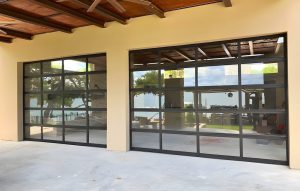
The opener is where the commercial-versus-residential distinction is most operationally significant. For commercial and residential opener options, the specifications differ substantially:
Residential openers use standard 120V household power, are rated for 10 to 15 cycles per day, use a trolley-rail system that pulls the door along a rail, and include basic safety features. Most residential openers are rated for doors up to 14 feet wide and 500 to 700 pounds.
Commercial operators use 208V to 480V three-phase power (or higher-amperage single-phase in smaller applications), are rated for continuous duty, are typically ceiling-mounted or jackshaft-mounted rather than rail-mounted, and include commercial-grade logic boards that support access control systems, vehicle loop detectors, and building management system integration. Running a residential opener on a commercial door will burn out the motor and voids the warranty.
Choosing the Right Door for Your Property
For commercial property owners and managers in Cedar Creek, Bastrop, Lockhart, Del Valle, and the TX-130 business corridor, commercial overhead door installation is the right choice when: the door will cycle more than 10 to 15 times per day, the opening is wider than 16 feet or taller than 8 feet, the door separates a commercial space from an occupied area by code, or access control integration is required.
For residential customers — including homeowners with large properties, RV garages, or agricultural outbuildings — a residential door is appropriate as long as the usage pattern stays within residential cycle rates. A residential door on a barn or outbuilding that cycles 3 to 4 times daily will serve well for its rated lifespan. That same door used on a working agricultural property that cycles 20 times daily will fail within a few years.
Maintenance: Commercial vs Residential
Commercial garage doors require more frequent maintenance than residential doors, driven by their higher cycle counts. A residential door that cycles 4 times per day benefits from an annual professional inspection. A commercial door that cycles 20 to 40 times per day should be inspected quarterly. The increased inspection frequency allows technicians to catch spring wear, cable fraying, roller degradation, and operator stress before they cause a mid-day failure that shuts down a loading dock or blocks vehicle access.
In Central Texas climate, commercial doors in non-air-conditioned bays face additional stress from heat. Commercial operators in bays that regularly reach 110 to 130 degrees in summer should be checked for motor temperature compliance at each service visit. Lubrication requirements are also more frequent for commercial hardware — quarterly lubrication of all pivot points and spring shafts is standard for high-cycle commercial applications rather than the twice-yearly residential schedule.
How All Points Serves Both
All Points Garage Doors has handled both residential garage door repair and commercial overhead door service across Cedar Creek, Austin, Bastrop, Del Valle, and Lockhart since 2010. We are fully insured and carry parts for sectional doors, rolling steel doors, and commercial operators on every truck.
To get a commercial or residential estimate with no obligation, call (512) 796-4985 — fully insured, available 24/7 for both residential emergencies and commercial service calls across Cedar Creek and the Austin corridor.
